Limited Series Product Testers: US Policy Changes 2026

New policy regulations taking effect in the US by 2026 are set to transform the landscape for Limited Series Product Testers.
Aimed at enhancing consumer protection and standardizing testing protocols, these legislative shifts will significantly impact both individual testers and major manufacturers.
This guide breaks down what has changed, why it matters, and how key stakeholders can prepare for full compliance.
Understanding the New Regulatory Framework for 2026
The impending policy changes for Limited Series Product Testers in the US by 2026 represent a concerted effort to modernize and strengthen the framework governing product evaluations.
These updates stem from a growing need for enhanced accountability and consumer safety in a rapidly evolving market.
Authorities have emphasized that the core objective is to ensure that products reaching the market, especially those in limited series, undergo rigorous and standardized testing.
This proactive approach aims to mitigate risks associated with untested or inadequately tested goods, fostering greater public trust.
The specific provisions of these new policies touch upon various aspects, from tester qualifications to data submission requirements, creating a more structured environment for product testing.
The implications for Limited Series Product Testers in the US by 2026 are far-reaching, necessitating a thorough review by all participants.
Key Legislative Drivers and Their Origins
The legislative push behind these policy changes is rooted in several high-profile incidents involving product safety and efficacy.
Public outcry and consumer advocacy groups have played a pivotal role in bringing these issues to the forefront, prompting lawmakers to act.
Furthermore, technological advancements in product development and manufacturing have outpaced existing regulations, creating gaps that these new policies aim to bridge.
The goal is to create a robust regulatory ecosystem capable of adapting to future innovations while safeguarding consumer interests.
Several federal agencies, including the Consumer Product Safety Commission (CPSC) and the Federal Trade Commission (FTC), have collaborated on drafting and refining these new guidelines.
Their combined expertise ensures a holistic approach to regulating Limited Series Product Testers in the US by 2026.
- Initial legislative proposals surfaced in late 2023, driven by consumer safety concerns.
- Public consultations and industry feedback shaped the final version of the policy.
- The official announcement detailing the changes was made in early 2024, setting the stage for implementation.
Impact on Limited Series Product Testers
The new policies will introduce several significant changes for individuals and entities operating as Limited Series Product Testers in the US.
These adjustments are designed to professionalize the testing process and ensure greater consistency in results, directly affecting daily operations.
Testers will likely face stricter eligibility criteria, potentially requiring specific certifications or demonstrated expertise in relevant product categories.
This move aims to elevate the quality of feedback and data collected, ensuring that only qualified individuals participate in sensitive testing programs.
Moreover, the reporting mechanisms for test results are expected to become more standardized and comprehensive.
This will require testers to adopt new methodologies for documenting their findings, impacting the workflow for Limited Series Product Testers in the US by 2026.
Enhanced Data Collection and Reporting Standards
One of the most notable shifts involves the requirements for data collection and reporting.
The new policies mandate a higher level of detail and accuracy in all submitted test reports, moving towards a more empirical and verifiable approach.
This includes standardized templates for feedback, clear guidelines on documenting product performance, and potentially the use of approved digital platforms for submission.
Such measures aim to reduce ambiguity and enhance the utility of tester feedback for manufacturers.
For Limited Series Product Testers in the US by 2026, this means an increased emphasis on meticulous record-keeping and adherence to prescribed reporting formats.
Training programs may become necessary to adapt to these new procedural demands.
- Mandatory use of standardized feedback forms and digital reporting platforms.
- Increased scrutiny on data integrity and verifiable testing conditions.
- Requirement for detailed photographic or video evidence in certain test scenarios.

Manufacturers engaging Limited Series Product Testers in the US by 2026 will also bear increased responsibility for ensuring their testers comply with these new standards.
This includes providing adequate training and resources to facilitate adherence to the updated guidelines.
Implications for Manufacturers and Brands
Manufacturers and brands that rely on Limited Series Product Testers in the US will need to re-evaluate their current testing strategies and operational procedures.
The policy changes are not just about individual testers; they extend to the entire ecosystem of product development and quality assurance.
Compliance will require significant internal adjustments, from updating contractual agreements with testers to investing in new technologies for data management and analysis.
Brands must ensure their testing programs meet the new regulatory benchmarks to avoid penalties and maintain market access.
The overall cost of product testing might see an increase due to enhanced requirements and potential training needs for testers.
However, this investment is expected to yield higher quality products and reduced risks of recalls or consumer complaints for Limited Series Product Testers in the US by 2026.
Adapting Internal Processes for Compliance
To navigate these new regulations effectively, manufacturers must conduct a thorough internal audit of their existing product testing protocols.
This audit should identify any gaps between current practices and the forthcoming 2026 requirements.
Key areas for review include tester recruitment, training modules, data collection methodologies, and the process for integrating tester feedback into product refinement.
Proactive adaptation will be critical to a smooth transition and continuous operation.
Developing clear internal guidelines and standard operating procedures (SOPs) that reflect the new policies will be essential.
This ensures that all employees involved in product development and testing are aligned with the new regulatory landscape for Limited Series Product Testers in the US by 2026.
- Updating contracts with product testers to reflect new compliance obligations.
- Investing in secure, compliant platforms for managing tester data and feedback.
- Establishing internal audit mechanisms to regularly check adherence to new regulations.
Timeline and Implementation Phases Towards 2026
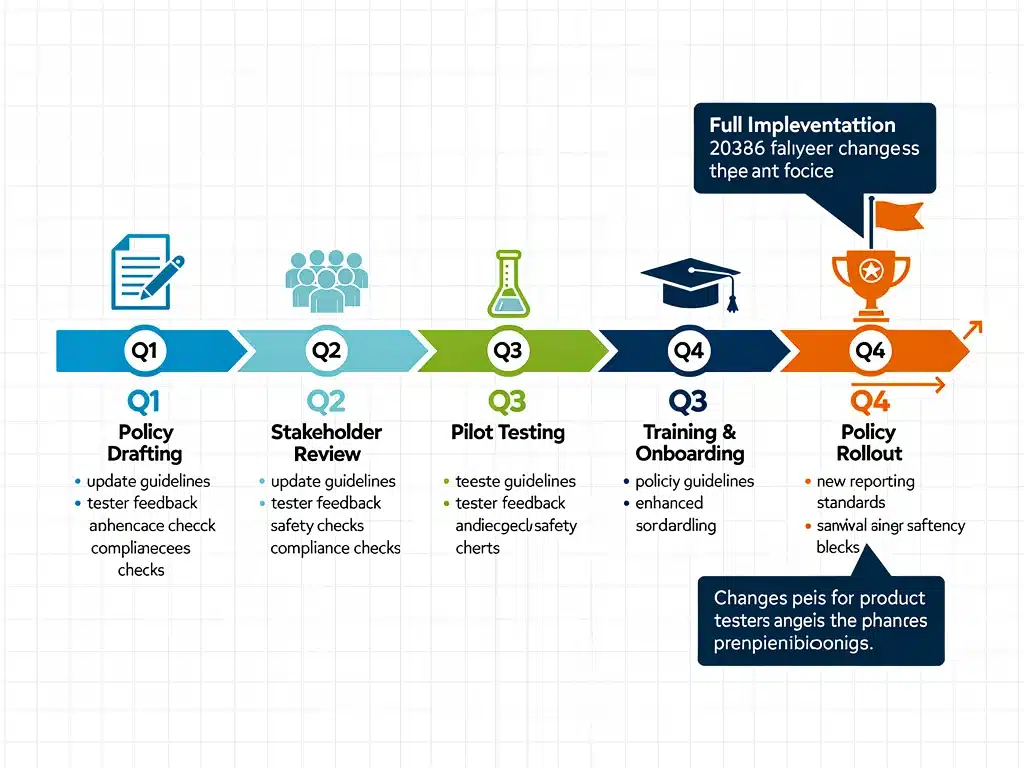
The transition to the new regulatory environment for Limited Series Product Testers in the US by 2026 is structured in several phases, designed to allow ample time for adaptation.
Understanding this timeline is crucial for all stakeholders to plan their preparations effectively and avoid last-minute disruptions.
The initial phase, which began in mid-2024, focused on disseminating information and conducting educational outreach programs for both testers and manufacturers.
This period aimed to raise awareness about the upcoming changes and provide resources for understanding the new requirements.
The subsequent phases will involve pilot programs and staggered implementation, allowing for feedback and adjustments before the full enforcement date in 2026.
This phased approach underscores the authorities’ commitment to a smooth and manageable transition for Limited Series Product Testers in the US by 2026.
Key Milestones and Deadlines to Observe
Several critical dates and milestones have been set forth by regulatory bodies, marking important checkpoints in the implementation process.
Missing these deadlines could result in compliance issues, making diligent tracking indispensable.
For instance, specific dates have been designated for mandatory registration of testing programs and for the submission of initial compliance plans from manufacturers.
Testers might also face deadlines for completing new certification courses.
The final deadline for full compliance is set for January 1, 2026, by which point all aspects of the new policies must be strictly adhered to by all Limited Series Product Testers in the US. Staying informed about these dates is paramount for all involved parties.
- Mid-2024: Public awareness campaigns and release of detailed guidance documents.
- Early 2025: Commencement of pilot programs and voluntary compliance initiatives.
- January 1, 2026: Full enforcement of all new policy changes begins nationwide.
Benefits and Challenges of the New Policies
While the Recent Updates: Policy Changes Affecting Limited Series Product Testers in the US for 2026 present certain challenges, they also offer substantial benefits for consumers, manufacturers, and the testing industry as a whole.
A balanced perspective reveals both sides of this regulatory coin.
On the benefit side, increased standardization and oversight are expected to lead to higher quality and safer products reaching the market.
This enhances consumer trust and reduces the incidence of product-related harm, creating a more reliable marketplace.
For manufacturers, while initial compliance costs may be a concern, the long-term benefits include reduced liability risks, improved brand reputation, and more credible product feedback.
These advantages can outweigh the initial investment, benefiting Limited Series Product Testers in the US by 2026 indirectly.
Navigating Compliance Hurdles
The primary challenge for many stakeholders will be navigating the complexities of the new compliance requirements.
Small-scale manufacturers and independent Limited Series Product Testers in the US may find it particularly difficult to absorb the costs and administrative burden associated with these changes.
Another hurdle could be the potential for a temporary slowdown in product development cycles as companies adjust their testing phases to meet the new standards.
This might impact the speed at which innovative products reach consumers.
However, regulatory bodies have indicated a willingness to provide support and resources to facilitate compliance, including educational materials and potential grace periods for certain aspects.
This collaborative approach aims to ease the transition for Limited Series Product Testers in the US by 2026.
- Potential for increased operational costs and administrative overhead.
- Need for significant investment in training and technological upgrades.
- Risk of temporary delays in product launch schedules during the transition period.
Ensuring Ethical Testing Practices
A core component of the Recent Updates: Policy Changes Affecting Limited Series Product Testers in the US for 2026 is a renewed emphasis on ethical testing practices.
This includes safeguarding tester privacy, ensuring fair compensation, and preventing conflicts of interest, all crucial for maintaining integrity.
The new guidelines are expected to introduce stronger protections for product testers, ensuring they operate in safe environments and are not subjected to undue pressure or exploitation.
This ethical foundation is vital for attracting and retaining high-quality testers.
For manufacturers, establishing clear ethical guidelines and transparent communication with their Limited Series Product Testers in the US by 2026 will be paramount.
This fosters a relationship of trust and respect, contributing to more reliable and honest feedback.
Protecting Tester Rights and Privacy
The new policies are anticipated to include explicit provisions regarding tester data privacy and the protection of personal information.
This is a critical step in building confidence among testers and encouraging participation in testing programs.
Manufacturers will be required to implement robust data security measures and adhere to strict privacy policies when collecting and storing tester data.
Transparency about how data is used and shared will also be a key requirement.
Ensuring fair compensation and clear terms of engagement for Limited Series Product Testers in the US by 2026 will also be a focus.
This includes outlining payment schedules, product retention policies, and any other benefits or obligations associated with testing participation.
- Mandatory adherence to data privacy regulations like GDPR or CCPA where applicable.
- Clear disclosure of terms and conditions for product testing participation.
- Provisions for anonymous feedback channels to protect testers from potential retribution.
Looking Ahead: The Future of Product Testing
The Policy Changes Affecting Limited Series Product Testers are set to reshape the future of product testing, fostering an environment of greater accountability and innovation.
This forward-looking perspective suggests a more robust and credible industry landscape.
As these policies take full effect, the industry can expect a heightened focus on specialized testing, utilizing advanced methodologies and technologies.
This evolution will likely lead to more sophisticated product evaluations, benefiting both consumers and businesses.
The long-term vision is to establish a gold standard for product testing in the US, making it a benchmark for international markets. This ambitious goal underscores the transformative potential of these changes for Limited Series Product Testers in the US by 2026.
Emerging Trends and Technological Integration
The regulatory shifts are likely to accelerate the adoption of new technologies in product testing.
Artificial intelligence (AI) and machine learning (ML) could play a more significant role in analyzing tester feedback and identifying patterns or anomalies.
Virtual and augmented reality (VR/AR) might also be integrated into testing processes, allowing for more immersive and controlled testing environments for certain product categories.
These innovations promise to enhance efficiency and accuracy.
Furthermore, the emphasis on data-driven insights will encourage the development of more advanced analytics tools for manufacturers.
These tools will help in translating raw tester feedback into actionable product improvements, benefiting Limited Series Product Testers in the US by 2026 indirectly.
- Increased investment in AI-powered analytics for interpreting tester data.
- Exploration of VR/AR for simulating product usage in controlled environments.
- Development of blockchain technology for secure and transparent record-keeping of test results.
| Key Aspect | Brief Description |
|---|---|
| Tester Qualifications | Stricter eligibility and potential certification requirements for testers. |
| Reporting Standards | Enhanced detail and standardization in data collection and submission. |
| Manufacturer Compliance | Brands must adapt internal processes and invest in compliant systems. |
| Ethical Guidelines | Stronger protections for tester privacy, fair compensation, and conflict prevention. |
Frequently Asked Questions About 2026 Policy Changes
The main goals are to enhance consumer protection, standardize testing protocols, and improve regulatory oversight for Limited Series Product Testers in the US. These updates aim to ensure higher quality and safer products reach the market, building greater public trust and accountability.
Individual product testers may face stricter eligibility criteria, potentially requiring certifications or specialized training. There will also be enhanced requirements for data collection and reporting, demanding more meticulous documentation and adherence to standardized formats for Limited Series Product Testers in the US.
Manufacturers should conduct internal audits of current testing practices, update contractual agreements with testers, and invest in compliant data management systems. Providing training and resources to ensure their Limited Series Product Testers in the US meet new standards is also crucial for seamless transition.
Yes, there could be increased operational costs for both testers and manufacturers due to enhanced requirements, training, and technological upgrades. However, these investments are expected to lead to long-term benefits like reduced liability and improved product quality, benefiting Limited Series Product Testers in the US.
Official resources and detailed guidance documents are being released by federal agencies such as the Consumer Product Safety Commission (CPSC) and the Federal Trade Commission (FTC). Stakeholders should regularly check their official websites for the latest updates and compliance information relevant to Limited Series Product Testers in the US by 2026.
Looking Ahead: The Future of Product Testing
The Recent Updates: Policy Changes Affecting Limited Series Product Testers in the US for 2026 signify a pivotal moment for the product testing industry.
These changes are not merely regulatory hurdles but a foundational shift towards a more transparent, accountable, and ultimately, more effective system.
Stakeholders must remain vigilant, adapting their practices to align with the new standards and leverage the opportunities that arise from a more structured environment.
The focus now shifts to proactive engagement and continuous adaptation, ensuring that the US remains at the forefront of product safety and innovation.
For consumers looking to participate in these programs, exploring reputable platforms that partner with brand testing panels provides a practical starting point.